Use of Force

× Clear Filters
188 Articles
U.S. President Donald Trump (R) and South Korean President Lee Jae-myung talk to reporters before an Oval Office meeting at the White House on August 25, 2025 in Washington, DC. During Lee's first official visit to the White House, the two leaders are set to discuss trade and military cooperation to counter North Korea and China, South Korea's top trade partner. (Photo by Chip Somodevilla/Getty Images)

Legal and Policy Options for a U.S-South Korea Nuclear Submarine Program

Trump’s announcement 'approving' a nuclear-powered submarine plan with South Korea contradicts U.S. law requiring specific terms, agreements, and congressional review.
Collection: U.S. Lethal Strikes on Suspected Drug Traffickers

Collection of expert analysis on the legality of the U.S. strike on Venezuelan vessels in the Caribbean, the consequences of the strike, and related issues.
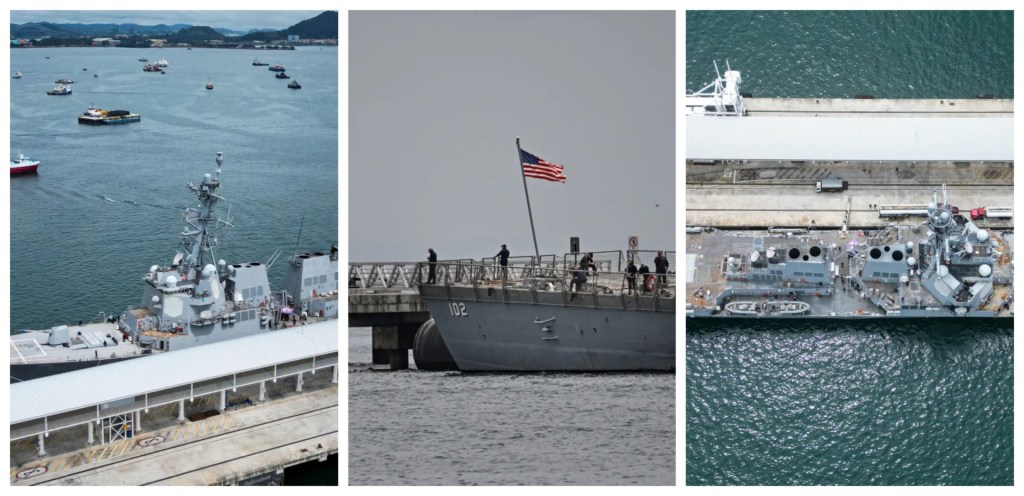
The US Navy warship USS Sampson (DDG 102) docks at the Amador International Cruise Terminal in Panama City on September 02, 2025. Venezuelan President Nicolas Maduro said on September 1, 2025, that eight US military vessels with 1,200 missiles were targeting his country, which he declared to be in a state of "maximum readiness to defend" itself. (Photo by MARTIN BERNETTI/AFP via Getty Images)

Timeline of Vessel Strikes and Related Actions

A timeline that chronicles major events in the Trump administration’s campaign of lethal strikes against suspected drug traffickers in the Caribbean and Eastern Pacific.
WASHINGTON, DC - JUNE 18: U.S. Secretary of Defense Pete Hegseth arrives to testify before the Senate Armed Services Committee in the Dirksen Senate Office Building on June 18, 2025 in Washington, DC. The Committee met to hear testimony on the proposed budget request for fiscal year 2026 and the future year's defense program for the Department of Defense. (Photo by Kayla Bartkowski/Getty Images)

U.S. Boat Strike Campaign: Questions Congress Should Ask Executive Branch Officials

A list of questions that should be answered by U.S. government officials regarding the lethal campaign against suspected drug trafficking individuals, groups, and vessels.
WASHINGTON, DC - DECEMBER 02: U.S. Secretary of Defense Pete Hegseth (R) looks on as U.S. President Donald Trump speaks during a meeting of his Cabinet in the Cabinet Room of the White House on December 02, 2025 in Washington, DC. (Photo by Chip Somodevilla/Getty Images)

Expert Q&A on the U.S. Boat Strikes

An expert Q&A on the Trump administration's lethal strikes against suspected drug trafficking boats on the high seas.
Members of Venezuelan army stand at a table showing weapons to a crowd of civilian onlookers.

As Trump Presses for a Post-Maduro Venezuela: Questions, Lessons, and Warnings for the Aftermath

As the Trump administration positions for possible military strikes, it would be wise to prepare for looming governance and stability challenges in Venezuela.
(L/R) South Korea's Foreign Minister Cho Hyun, Germany's Foreign Minister Johann Wadephul, Mexico's Foreign Minister Juan Ramon de la Fuente, US Secretary of State Marco Rubio, European Union High Representative for Foreign Affairs and Security Policy Kaja Kallas, Canada's Foreign Minister Anita Anand, Japan's Foreign Minister Toshimitsu Motegi, Britain's Foreign Secretary Yvette Cooper, Italy's Foreign Minister Antonio Tajani, France's Minister for Europe and Foreign Affairs Jean-Noel Barrot, and India's Foreign Minister Subrahmanyam Jaishankar gather for a photo during the G7 Foreign Ministers' meeting in Niagara-on-the-Lake, Canada, on November 12, 2025. (Photo by MANDEL NGAN/POOL/AFP via Getty Images)

The International Law Obligation of States to Stop Intelligence Support for U.S. Boat Strikes

The only way States can avoid complicity in “arbitrary killings” under international human rights law is to refrain from sharing intelligence that, in part, enables them.
An injured boy lays on his back in a van as two others attend to his wounds.

The Political Theater Behind Trump’s “Guns-a-Blazing” Nigeria Threat

Trump’s threat of military intervention in Nigeria may be intended more for domestic audiences and wouldn't address the drivers of the country's conflict.
The USS Gravely, a US Navy warship, departs the Port of Port of Spain on October 30, 2025. The US warship arrived in Trinidad and Tobago on October 26, 2025, for joint exercises near the coast of Venezuela, as Washington ratcheted up pressure on drug traffickers and Venezuelan leader Nicolas Maduro. (Photo by MARTIN BERNETTI/AFP via Getty Images)

U.S. Saber Rattling and Venezuela: Lawful Show of Force or Unlawful Threat of Force?

Clearly, U.S. actions are threatening to Venezuela. But do they amount to an unlawful threat under international law, or are they merely a lawful show of force?
US Marines' Lockheed Martin F35-B jets approach in formation

Dissecting the Trump Administration’s Effort to Circumvent the War Powers Resolution for Boat Strikes

The administration's legal argument is both "incorrect and dangerous," writes Finucane.
US Capitol building at sunset with moon

Expert Backgrounder on War Powers Resolution 60-Day Clock for Boat Strikes Expiring Monday

Expert backgrounder on how War Powers Resolution works in application to U.S. military operations against suspected drug cartels.
Crew members of the US Navy warship USS Sampson (DDG 102) are pictured at the Amador International Cruise Terminal in Panama City on September 02, 2025. Venezuelan President Nicolas Maduro said on September 1, 2025, that eight US military vessels with 1,200 missiles were targeting his country, which he declared to be in a state of "maximum readiness to defend" itself. (Photo by MARTIN BERNETTI/AFP via Getty Images)

The Caribbean Strikes and the Collapse of Legal Oversight in U.S. Military Operations

Congress and the public must do more to address the dangerous pressures imposed on servicemembers and defend the guardrails that protect both U.S. forces and democracy.
1-12 of 188 items

DON'T MISS A THING. Stay up to date with Just Security curated newsletters: